E-Forest — Internet of Trees
A field-tested monitoring system designed to detect illegal tree cutting, poaching, and wildfires in remote forests, then carry useful alerts to the people responsible for responding.
A signal becomes a place, a decision, and a route.
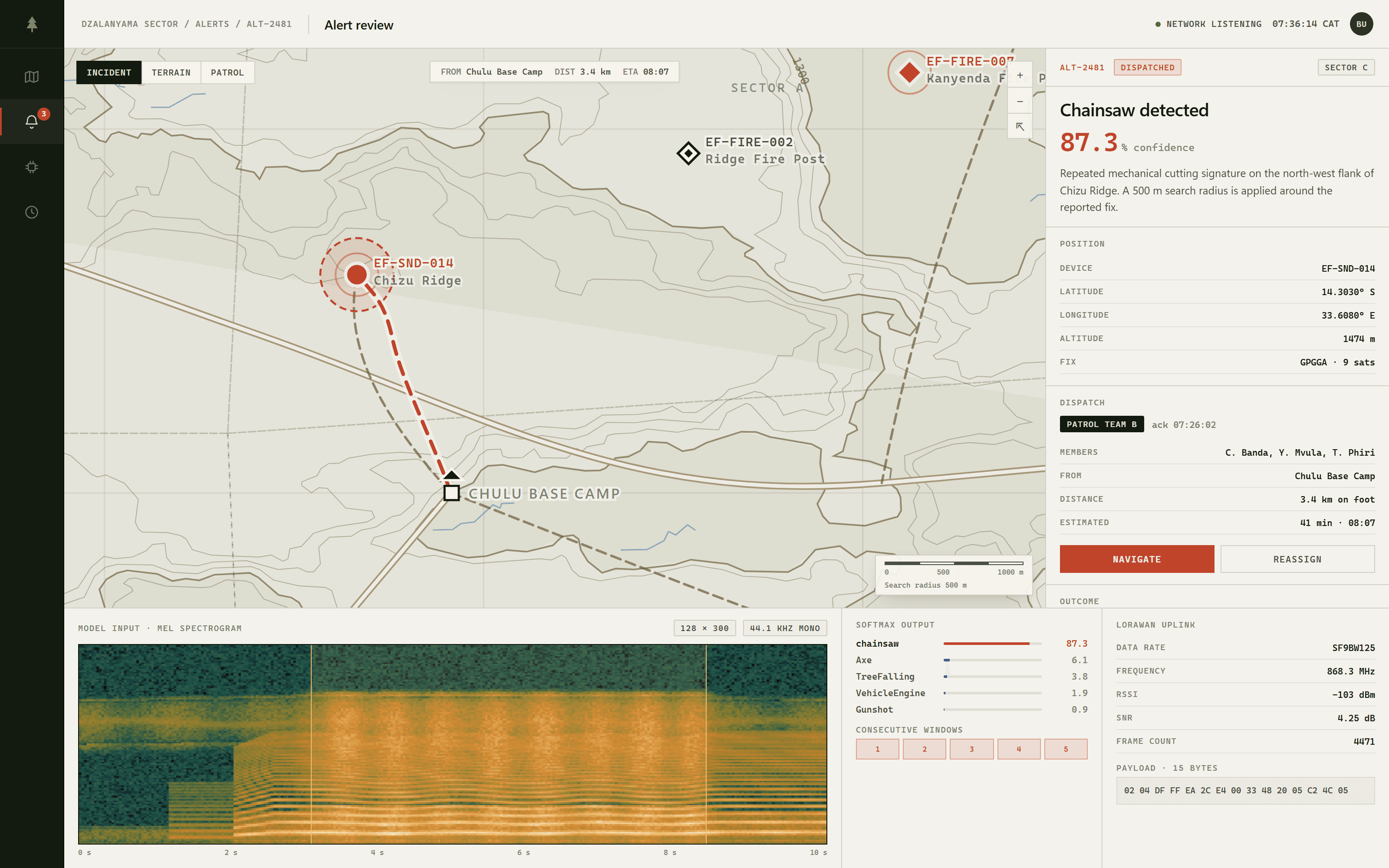
Location, search radius, route planning, and edge-signal review share one response surface.
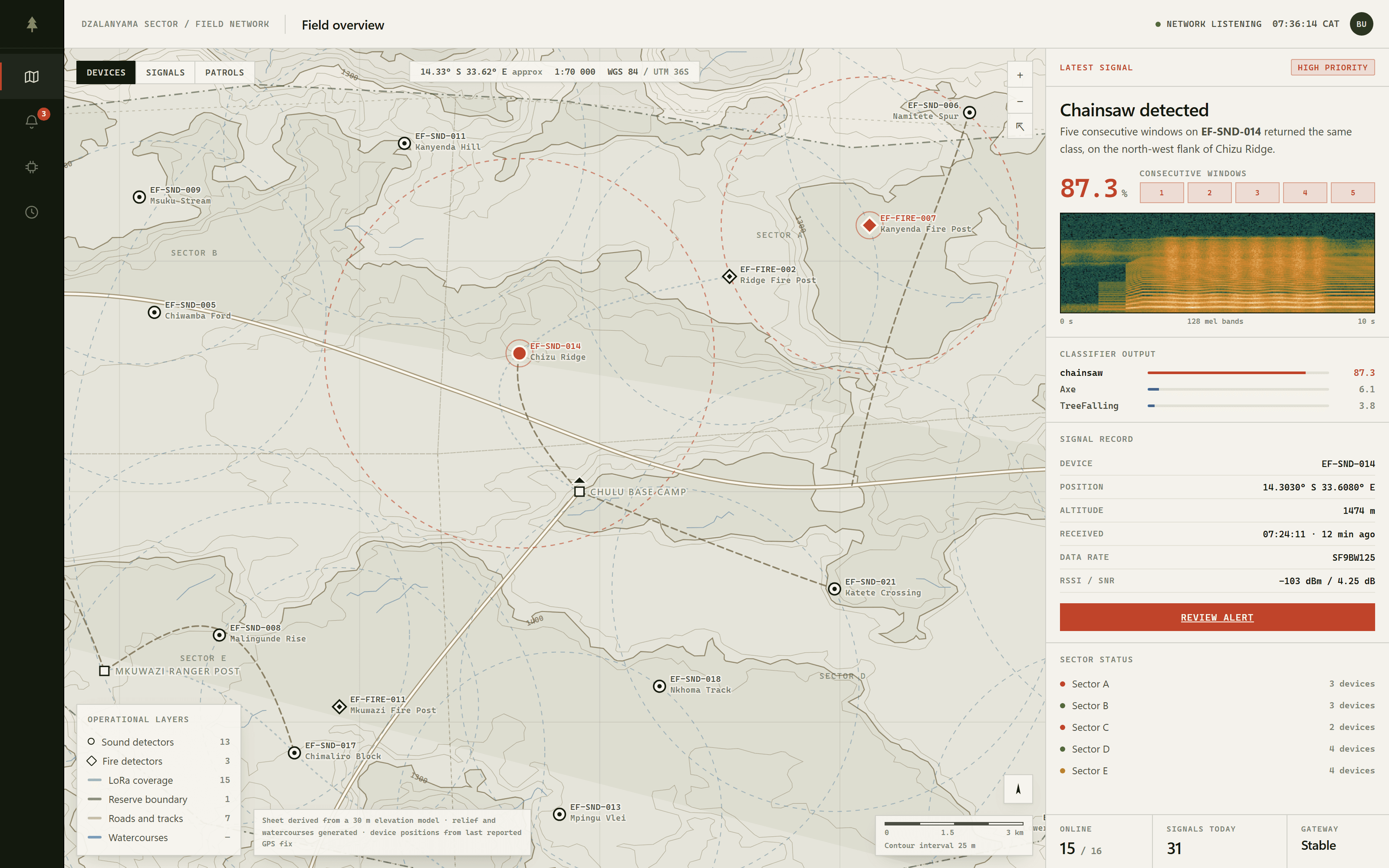
Coverage, device health, field conditions, and incidents remain spatially connected.
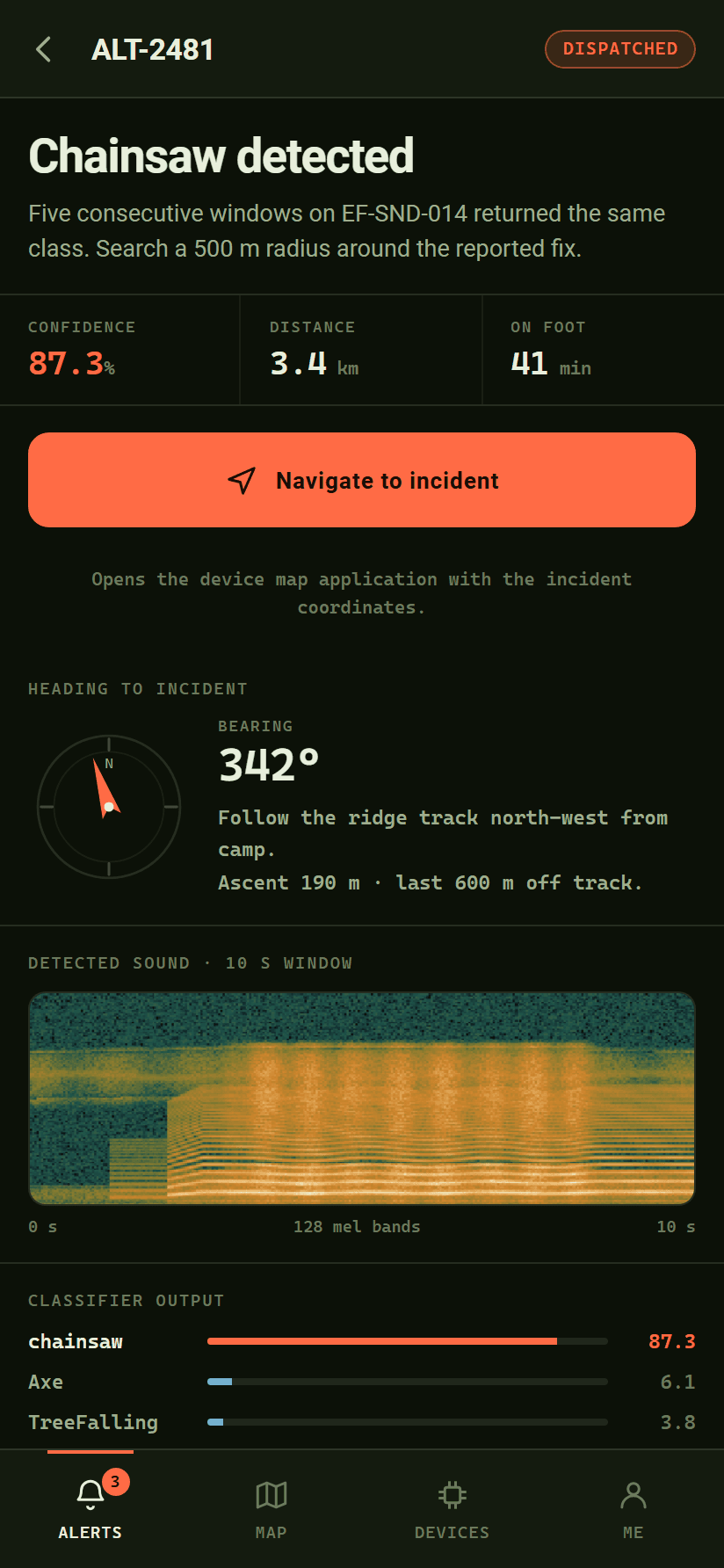
Bearing, navigation, and signal evidence carry the incident from review into the field.
The idea existed before the budget.
E-Forest began as a university idea: use connected field devices to detect threats that are difficult to see across a large forest. The first version could not move forward then because the physical prototype required hardware beyond a practical student budget.
A later Save the Children-supported innovation programme created a route from concept to components, technical incubation, prototype iteration, and field testing. The hardware opened that route. The harder task was turning a broad conservation idea into a system that had to survive real power, transport, coverage, and response constraints.
Three signals shaped the brief.
The system focused on threats where earlier awareness could support a faster field response: illegal tree cutting, poaching, and wildfire.
- 01
Illegal tree cutting
Listen for activity associated with unauthorised tree cutting so rangers could be alerted sooner.
- 02
Poaching
Recognise threat sounds associated with poaching, with elephant protection a primary concern.
- 03
Wildfires
Surface signs of fire through the wider field-device system before an incident spread further.
Carry the event, not the raw forest.
The device listened and classified sound in the forest. Instead of sending continuous audio, it sent a smaller event and its location through a gateway to web and mobile views.
- 01 / EVENT
Forest event
Illegal tree cutting, a poaching-related threat sound, or a fire event occurs in the forest.
- 02 / SENSE
Microphone + sensors
A field device listens close to the source and gathers the relevant input.
- 03 / INFER
Edge inference
A Raspberry Pi processes the audio locally and classifies the event.
- 04 / PACKAGE
Event + location
The result is reduced to a useful alert and paired with GPS location data.
- 05 / RELAY
LoRa + gateway
A low-bandwidth radio path carries the event out of the remote site.
- 06 / NETWORK
The Things Network
The gateway passes the message into the network and application pathway.
- 07 / DELIVER
Webhook + applications
The backend stores the event for the web interface and Android wrapper.
- 08 / RESPOND
Alert + response
The responsible team can see what was detected and where it happened.
Monitoring resumes →
Event → response → monitoring
Before the device could listen, we had to learn what to hear.
Over three days in Kasungu, the team worked with an audio engineer and forest rangers to capture real ambience, understand threat behaviour, and record controlled examples of sounds the system needed to recognise.
- 01 / LEARN
Understand how the forest is used.
Rangers explained how illegal logging and poaching happened in practice, which tools were commonly used, and which sounds mattered in a real response context.
- 02 / LISTEN
Capture the natural baseline.
Working with an audio engineer, the team recorded raw forest ambience so target events could be understood against the environment around them.
- 03 / SIMULATE
Recreate representative events.
The collection included controlled tree-cutting activity using representative tools and authorised firearm shots, recorded with ranger involvement.
- 04 / PREPARE
Turn recordings into usable source material.
The raw and simulated recordings created the basis for organising event classes and developing the sound-detection model.
Decisions made for the constraint.
Process at the edge
Classify audio near the source and transmit the event rather than relying on continuous raw-audio transfer.
Design for the site
Use long-range, low-bandwidth communication and consider battery/solar operation because grid power and dependable internet could not be assumed.
Connect event to response
Pair the detection event with location and an interface that could support a practical ranger response.
A lead contribution inside a team.
Believer originated the project and led its software and system development. A later collaborator focused mainly on hardware and also supported software work.
- 01
Originated the concept and carried it from early proposal through prototype development and field testing.
- 02
Worked across edge software, application integration, web/mobile delivery, and the wider device-to-alert workflow.
- 03
Participated in data collection, prototype iteration, deployment, ranger training, monitoring, and technical troubleshooting.
Iteration changed the operating plan.
Early planning, communication, scope, and procurement constraints pushed the team toward clearer roadmaps, regular check-ins, scoped milestones, stakeholder workshops, and tighter iteration.
From idea to field trial.
E-Forest progressed from an unaffordable university idea to a supported, iterated prototype tested at Dzalanyama Forest Reserve. The work carried one system from an early constraint and architecture through to real field conditions.
Sources and system material
Kasungu data collection
Supports the three-day sound-collection story, audio-engineer collaboration, ranger context, and controlled event recordings.
Pilot-testing report
Documents the later Dzalanyama prototype installation, monitoring, ranger training, detected events, and field constraints.
Save the Children Italy — 2023 social report
Identifies Believer as the project originator and first-place programme winner. Open source ↗
Architecture pathway
Reconstructed from available repositories and documentation as a concise explanatory view.
Technology in context
Edge + ML
Python · Raspberry Pi · PyAudio · Librosa · TensorFlow / Keras · GPS
Field hardware
Microphone input · LoRa · Arduino fire-detector prototype
Network + backend
The Things Network · Express.js webhook · PHP / JavaScript · MySQL
Interfaces
Web application · Leaflet / OpenStreetMap · Kotlin Android wrapper